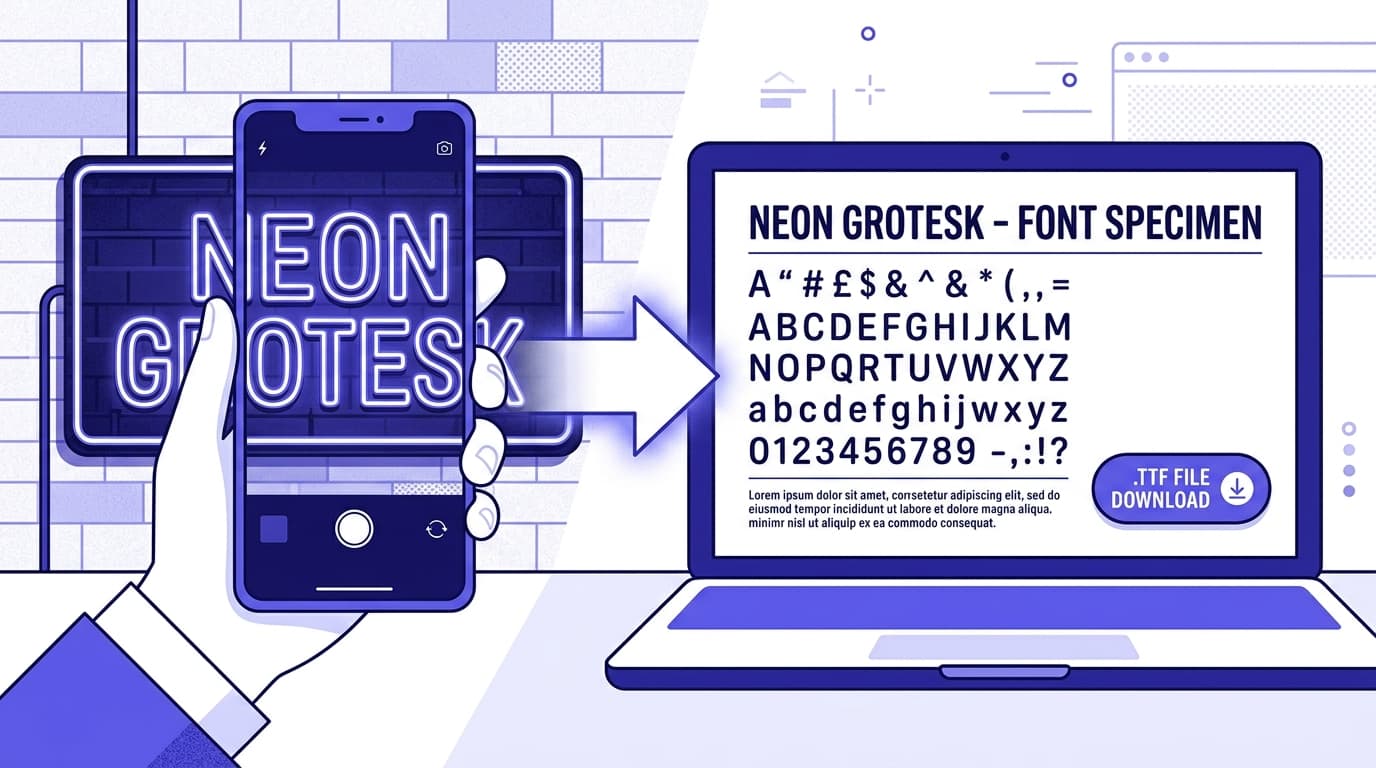
A photograph of lettering can spark a deceptively difficult question: is it legal to recreate a font from an image? Designers, small businesses, and historians often want to turn a sign, book cover, handwritten note, or vintage package into usable type. The practical task may be straightforward—identify the letterforms, draw missing characters, and export a font file—but the legal analysis depends on far more than whether the finished font “looks similar.”
Font copyright law is nuanced because a typeface, a digital font file, the software used to generate it, a logo made with it, and the name under which it is sold may each receive different forms of protection. The answer also changes by country. In the United States, for example, the visual design of ordinary typefaces generally has limited copyright protection, while the digital font program can be protected as computer software. In other jurisdictions, typeface designs may qualify for copyright, registered design protection, or both.
This article provides a practical framework for assessing custom font legality before you recreate lettering from an image. It is general educational information, not legal advice. If a font will be used in a high-value brand, commercial product, large campaign, or dispute-sensitive project, consult an intellectual-property attorney in the jurisdiction where you will create, distribute, and use it.

What Is Protected Under Font Law?
The first step in any font IP law analysis is separating the different things people casually call “a font.” Those things are related, but they are not legally identical.
### Digital font files and font software
A modern OpenType or TrueType file contains instructions that tell software how to display glyphs at different sizes, position characters, apply ligatures, and perform other typographic functions. In many places, particularly the United States, those instructions may be protected as computer software. Copying a font file, extracting its outlines, modifying it, or distributing a derivative version can therefore create legal risk even when the typeface design itself is not independently copyrighted.
For example, purchasing a desktop license for a commercial font does not usually authorize you to send the .OTF file to a contractor, upload it to a public download page, convert it into a webfont, or use it to create and sell a competing font. The license agreement can impose rules beyond default copyright law, and those contractual rules matter. Always read the end-user license agreement, especially for web use, app embedding, logo use, editable templates, and redistribution.
### Typeface designs in different jurisdictions
The visual appearance of letters—the shapes of the A, R, ampersand, numerals, and punctuation—is often called the typeface design. In the United States, typeface designs have historically been treated as useful articles and generally are not protected by copyright as pictorial or graphic works. That does not mean every recreation is automatically safe. Other rights may still apply, and the law can differ substantially outside the United States.
In the United Kingdom and parts of Europe, for instance, typeface designs may receive protection through copyright, unregistered design rights, registered designs, or related laws. The duration and requirements depend on the country and the precise claim. A font reproduction legal in one jurisdiction may not be legal to make or sell in another.
### Names, trademarks, and branding
A font name can be protected by trademark law even if the letter shapes are not. You might be able to develop an independently drawn typeface with a similar historical style, yet still be prohibited from marketing it under a confusingly similar name. Calling a new font “Helvetica Replica,” for example, can create trademark and consumer-confusion issues regardless of how the outlines were made.
Trademarks also matter when lettering is part of a recognizable brand. The distinctive script in a logo, a sports team wordmark, or a product label may implicate trademark, trade dress, or unfair-competition law. Recreating those letters as a font and promoting it as a way to imitate that brand is much riskier than studying generic 1970s bubble lettering.
### Contracts and access restrictions
Rights do not arise only from statutes. If you obtained a source image, a font file, or design assets through a client agreement, subscription, marketplace, or employer, you may have accepted contractual restrictions. A foundry might expressly prohibit reverse engineering, outline extraction, or derivative works. A client may own work created during a commission. These facts are central to whether you can copy a font legally, even where copyright protection is narrow.

What Is Often Not Protected—and Why That Is Not a Free Pass
When people ask, “Is it legal to recreate a font?” they often expect a simple yes or no. The more accurate answer is that some elements may be unprotected while the overall project remains constrained by other rights.
In the United States, ordinary alphabetic letterforms and familiar typographic features may not receive standalone copyright protection. General ideas and styles are also not protected. You are usually free to create a typeface inspired by broad characteristics such as high contrast, geometric construction, Art Deco proportions, a monoline handwritten feel, or chunky serif forms. No single company owns “retro,” “elegant,” or “rounded sans serif” as a concept.
Facts and short functional conventions are usually outside copyright as well. The basic fact that an uppercase E has three horizontal strokes, or that punctuation must remain legible, does not belong to a particular foundry. This is why many fonts can share genre conventions without being copies.
However, “not protected by copyright” is not the same as “safe to trace and sell.” If you directly copy a commercial font’s digital outlines, use its font file as a source, preserve its data, or violate its license, software copyright and contract claims may be relevant. If the lettering comes from a famous logo, trademark claims can be stronger than a typeface claim. If the source is recent and tied to a known designer or foundry, foreign design protections may apply. And if your recreation is extremely close, the practical cost of responding to a complaint may be significant even if you believe you have a defense.
A useful distinction is between inspiration, observation, and duplication. Inspiration means adopting a general mood or historical reference. Observation means studying visible features—stroke contrast, x-height, terminals, spacing—and making your own design decisions. Duplication means tracing every visible contour, reproducing distinctive alternates, copying the full character set, or deriving data from an existing font file. The first two are generally easier to defend than the third, but the applicable country and underlying source still matter.
Lower-Risk Situations for Recreating Lettering
No use case is entirely risk-free, but several situations are commonly more manageable when approached carefully.
### Your own handwriting, artwork, or commissioned lettering
If you created the source lettering yourself, you ordinarily control the relevant rights and can turn it into a font. The same may be true for commissioned lettering if the agreement clearly gives you the necessary ownership or license. Confirm whether the artist transferred rights to you or merely licensed one limited use. A restaurant that paid an illustrator to paint a menu title, for example, may not automatically have permission to convert the lettering into a commercial font.
### Public-domain source material
Historic printed materials can be excellent source references, but age alone is not enough. Determine the copyright status of the original artwork in the relevant country, and consider whether a later digitization, restoration, or font adaptation introduced separately protected work. If you are basing a design on a genuinely public-domain 19th-century type specimen, document the source, publication date, and your research.
### Creating a limited internal font from approved assets
A company may want a font based on its own existing signs, packaging, or brand handwriting so employees can create consistent presentations and social graphics. When the company owns the original lettering and the font is used internally, the legal and commercial risk is typically lower. Still, define who owns the resulting font, where it can be installed, and whether vendors may access it.
### Designing from a style rather than a single font
Suppose you want a playful mid-century display face. Instead of tracing one poster, collect several public-domain references, list shared traits, and create a new system: different proportions, distinct terminals, original numerals, and a fresh spacing strategy. This approach produces a more useful font and gives you a stronger record that your work is an original interpretation rather than a clone.
For image-based projects, Snapafont can help convert your own handwriting or lettering reference into an editable, downloadable TTF starting point. The important legal point is that the tool does not transfer rights in the source image to you; you should only upload material you own, are licensed to use, or have otherwise determined is appropriate for your intended use.
Risky Scenarios to Avoid or Review Carefully
Certain facts should trigger a pause before you recreate font copyright-sensitive material.
### Tracing a currently sold commercial font
If the image clearly shows a font that is actively licensed by a foundry, tracing it character by character to avoid buying a license is a poor strategy. Even if a particular country offers limited protection for typeface shapes, copying may implicate the source font software, license terms, foreign rights, and unfair-competition theories. It also creates a business risk: many foundries monitor unauthorized copies and can identify highly distinctive glyph details.
### Extracting outlines or converting font files
Using font-editing software to pull vectors from a commercial .OTF or .TTF, then renaming and exporting the result, is much more direct than working from an image. This is the type of conduct most likely to involve protected font software and an explicit license violation. Do not assume that changing a few letters, adjusting weight, or adding a ligature turns a copied file into an independently owned font.
### Recreating famous logo lettering
A font based on the lettering of Coca-Cola, Disney, Barbie, Harley-Davidson, or another recognizable brand is particularly hazardous. The issue is not merely recreate font copyright; it is also likely to involve trademarks and consumer confusion. Even a disclaimer may not cure marketing that invites buyers to imitate a brand identity.
### Selling an “exact match” or using the original name
How you market a recreation matters. Phrases such as “exact clone,” “replacement for,” “identical to,” or “free version of” can be evidence of intentional copying and can confuse customers. Reusing the original font’s name or a near variation can create a separate trademark problem. If you have created an independent historical revival, use a distinct name and accurately describe its source and scope.
### Assuming a screenshot grants permission
A screenshot, PDF, social post, or photographed sign is evidence that lettering exists; it is not a license to reproduce it. Identify who made the lettering, whether the work is still protected, whether the image itself has copyright, and whether your intended use is private, internal, commercial, or distributable.
Best Practices for a Defensible Font Recreation Process
A careful process cannot guarantee that a font reproduction is legal, but it can reduce avoidable risk and help you make better decisions.
### Start with a rights checklist
Before drawing, record the source image, where you found it, the apparent creator, date, country, and intended use. Ask: Do I own this artwork? Is it public domain? Do I have a written license? Is it a current commercial typeface or famous logo? Will I distribute the font or only use it privately? A “yes” to the last two questions should lead to a deeper review.
### Avoid using protected digital source data
If your goal is an original font based on visual reference, work from images you are entitled to use rather than extracting outlines from someone else’s font file. Draw and space glyphs independently. Build your own character set, kerning, alternates, and technical data. Keep drafts and notes that show your development process.
### Add meaningful original design work
Do not stop at the letters visible in one image. Make deliberate choices about unshown glyphs, punctuation, diacritics, numerals, weights, and spacing. More importantly, do not simply extrapolate a near-identical full alphabet from a few sample letters. A thoughtful interpretation based on multiple lawful references is both more original and more valuable than a mechanical clone.
### Check licenses and jurisdictions before commercial release
For a font intended for sale, client delivery, app embedding, or international distribution, review the relevant licenses and territorial rules. If the source is associated with a foundry, contact the foundry about licensing or commissioning a custom modification. This can be less expensive than resolving a conflict after launch.
### Be transparent and use a distinct identity
Choose an original font name, avoid protected branding, and describe your work accurately. If a design is inspired by public-domain signage or your own archival material, say so without implying endorsement by a brand, foundry, or artist. Keep documentation of permissions, research, and source files in case a platform, client, or marketplace asks questions.
Finally, distinguish legal permission from professional ethics. Even where the law may allow a close recreation, intentionally cloning the work of a living designer or independent foundry can damage trust. When a licensed font is available and fits the project, purchasing the appropriate license is often the clearest and most respectful option.
Turn Lettering You Have the Rights to Use Into a Working Font
If you have original handwriting, approved brand lettering, a licensed illustration, or a verified public-domain reference, converting it into a usable font can save substantial production time. Prepare a clean, high-contrast image, use consistent letter samples where possible, and review the generated characters for spacing, ambiguous shapes, punctuation, and missing glyphs before relying on the result in a client project.
Snapafont makes that workflow approachable by turning an image into a downloadable TTF font file, giving you a practical starting point for internal brand assets, personal handwriting fonts, and authorized lettering projects. Visit snapafont.com to try it, and keep the rights checklist from this article alongside your creative process: use sources you own or are allowed to use, preserve documentation, and get legal guidance when the use is commercially important or uncertain.
Ready to turn your image into a font?
Upload any image and get a real, downloadable .TTF font file in seconds.
Try Snapafont Free →